Asbestos Exposure at E.I. Dupont Belle Works
For nearly a century, the DuPont plant at Belle was a cornerstone of life in the Kanawha Valley. Thousands of families east of Charleston depended on it for steady, reliable employment across generations. For many, it was the foundation on which entire careers and households were built.
It also exposed countless workers and their families to asbestos. Decades later, many are still living with the consequences.
A Plant Built on Coal
DuPont broke ground at Belle in 1925, situated on the Kanawha River roughly eleven miles upstream from Charleston. The location was chosen for its proximity to coal: the operation relied on coke produced from West Virginia bituminous, and minimizing transport distances was essential to its economics.
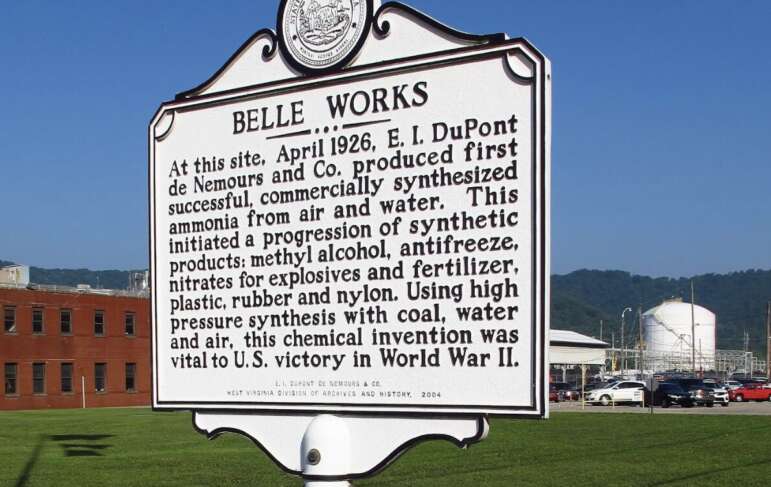
On April 1, 1926, Belle produced the first high-pressure ammonia manufactured in North America. At the center of the operation stood a row of massive compressors, known to workers as “hypers,” which compressed gas to 15,000 pounds per square inch—forcing hydrogen and nitrogen together to synthesize ammonia.
The plant expanded steadily from there. It produced the first commercial methanol in 1927, and from 1937 to 1946 manufactured the base chemicals for the world’s entire supply of nylon. Much of the nylon used by the U.S. military during World War II—including parachutes—originated with chemicals produced at Belle.
What the Plant Produced
The plant transformed coal and air into materials that helped build the modern world: Lucite, the transparent plastic used in fighter-plane canopies; Zerex antifreeze; hydraulic fluid; and fertilizer that supported agriculture worldwide. By the early 1950s, more than 5,000 people worked at Belle Works.
The plant evolved with industry. It transitioned from coke to natural gas in 1959, discontinued ammonia production in 1978, and shifted toward specialty chemicals. In 2015, the site became part of Chemours. Throughout these changes, one constant remained: the facility operated at high temperatures and under intense pressure, relying on equipment built to withstand extreme heat without igniting. That requirement is central to understanding how asbestos came to permeate the site.
Asbestos Was Everywhere
For much of the twentieth century, asbestos was regarded as a near-ideal industrial material. It resisted fire, heat, and chemical reaction; it was inexpensive; and it could be packed, sprayed, or wrapped wherever heat posed a risk. In a chemical plant filled with steam lines and reactors, those properties meant asbestos was used almost everywhere.
It insulated pipes, boilers, and pressure vessels. It sealed joints in the form of gaskets. It was packed into valves and pumps, sprayed on for fireproofing, and even woven into the gloves and aprons workers wore for protection. The very material relied upon to prevent burns also carried a serious, hidden danger.
Asbestos remains harmless only so long as it stays undisturbed. Cutting an old gasket, removing worn pipe insulation, or grinding a component during a repair releases microscopic fibers into the air. Workers inhaled them shift after shift, year after year, without warning of the risk they posed.
The Trades Most Affected
Some roles carried far greater exposure than others. Insulators and laggers handled raw asbestos directly. Pipefitters, boilermakers, millwrights, and maintenance crews disturbed asbestos gaskets and insulation each time equipment required servicing. Operators, welders, and electricians worked alongside them in the same conditions, and supervisors and engineers were exposed during routine inspections.
The danger did not remain confined to the plant. Fibers traveled home on workers’ clothing, hair, and boots—exposing spouses who laundered work garments and children who greeted a parent returning from a shift.
Compounding the harm is the long delay before symptoms appear. Mesothelioma and other asbestos-related diseases can take 20 to 60 years to develop. A worker employed at Belle in the 1960s or 1970s may have remained symptom-free for decades before receiving an unexpected diagnosis.
If your family has been affected by asbestos-related illness, you are not alone, and you have the right to seek answers and to determine who may be accountable.
At Goldberg, Persky & White, P.C., we have spent more than 40 years representing individuals and families affected by asbestos-related disease. Our work includes investigating chemical plants linked to Union Carbide, DuPont, FMC, and other manufacturers, identifying sources of exposure, and pursuing accountability for the harm caused.